A Wicked Case of Commons Brain
I have a condition. No, not one with an official diagnosis, but I do have a name for it. Commons brain.
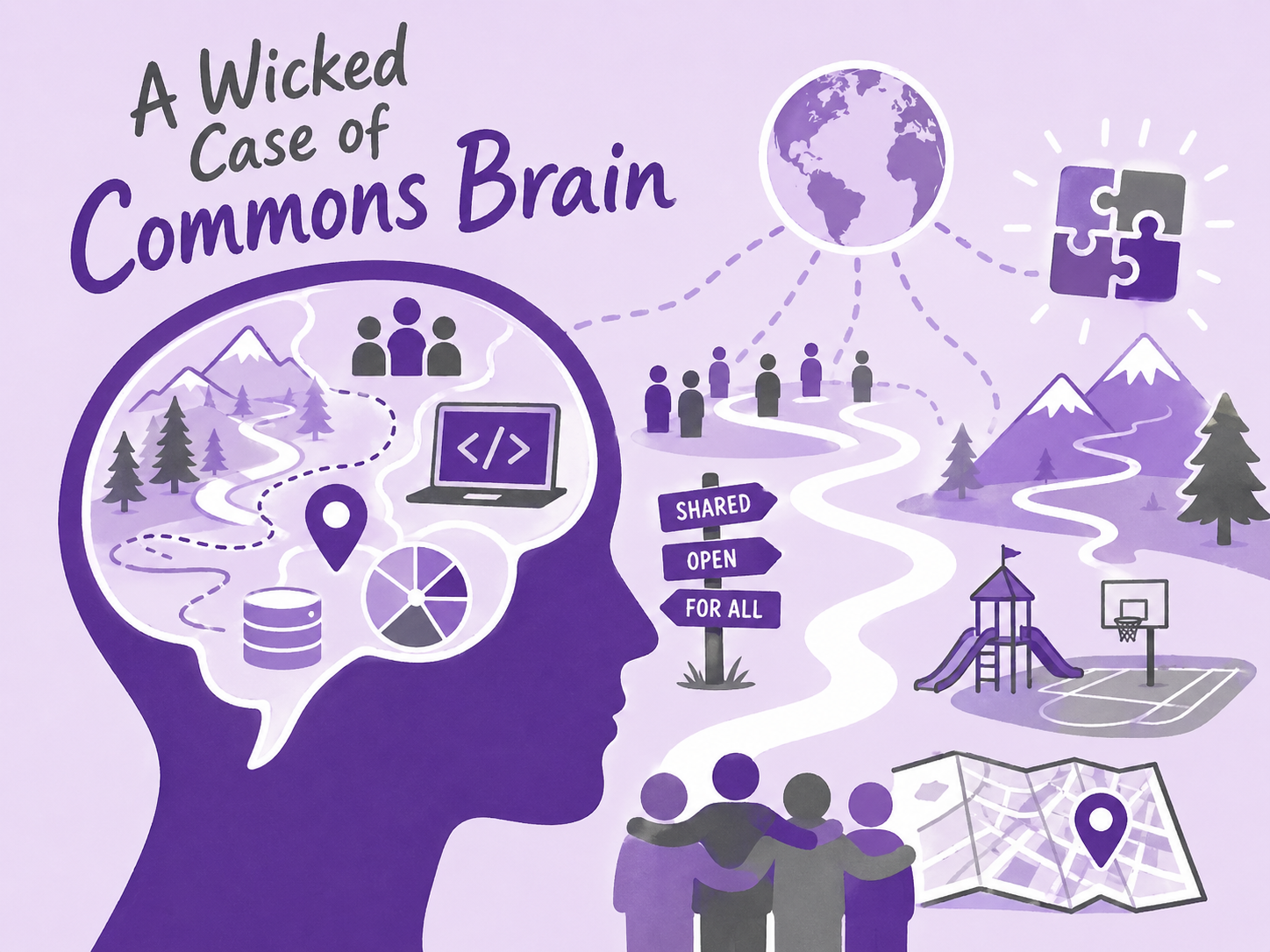
I have a condition. No, not one with an official diagnosis, but I do have a name for it. Commons brain — the part of the mind that looks at any shared resource and immediately asks: who gets to use this, who decides, and what would it look like if more people could?
It’s the part of my brain that looks at any shared resource: a hiking trail, a map, a piece of software, a dataset — and immediately starts asking: who gets to use this, who decides, and what would it look like if more people could?
This commons brain, I didn’t choose it. I caught it. Or maybe I inherited it. Or I developed it. I’m still not sure.
Nurture
My mom was PTA president. My dad was president of our religious congregation. They refereed youth sports, they coached, they showed up. Nobody sat down and explained why. It was just what you did. My mom is 78 now and still volunteers half a day a week at a hospital. It’s not a philosophy for her, it’s just what you do.
I don’t remember not having a computer. It started with the Intellivision and then a PC. We played Mavis Beacon Teaches Typing, worked through the King’s Quest series and dabbled in MUDs when we finally got AOL. The only creation or modification we did was messing with the DOS windowing system my dad had installed. Soon sick of it he locked the settings down with a password so we wouldn’t mess it. When we were truly stuck and needed it, he finally told us what the password was.
It was: askyourfather
We weren’t making things yet. We were users. I dabbled in code a little bit, but nothing serious. The idea that code was something a person wrote, or that software could be something a community built together, wasn’t part of my reality.
That came later.
Cubicles
After college, where I’d picked up Mandrake Linux and started poking at open source without fully understanding what I was touching, I ended up at a fairly typical large corporation. We had cubicles. We didn’t go to conferences. We didn’t contribute to anything open. We built things, shipped them, and moved on. The idea that you might build something and give it away, or that strangers might gather voluntarily to make something together, was not part of the world I was living in.
Then I found the unconferences and OpenStreetMap.
The unconference format sounds almost too simple: people gather, there’s no fixed agenda, and the attendees decide what gets talked about. The first time I walked into one in Washington, D.C., something shifted. People were there because they wanted to be. You could branch off, start a project, or even just walk away.
The commons brain was developing. I just didn’t have a name for it yet.
Spite Mapping
The diagnosis became official when I found OpenStreetMap.
My neighborhood in Sterling had hiking trails, sports courts, playgrounds. So did the neighborhood next door. Same resources, same county. The difference was that the neighborhood next door had put up signs and cameras: residents only, no trespassing.
So I started mapping. I walked every trail. I documented the paths that the signs were trying to pretend didn’t exist. I was making a public record of what was actually there, available to anyone who looked. Was it a little petty? Maybe. But the act of trespassing to collect the data was part of the point. I coined it spite mapping, and I still love to tell the story of it.
Mapping alone for a while and then I went to a mapathon and met other OpenStreetMap contributors in person. Then I went to State of the Map in Spain.
Fair warning: I gave the worst talk of my career at that conference. My flight turned around and landed in Boston. I arrived twenty-four hours late on no sleep. They asked if I wanted to go on stage immediately and my brain said yes before the rest of me could object. I forgot to introduce my topics. The first question after I stopped speaking was: “What is Geocommons?”
But I went to dinner with people who were building fascinating things. I met the global community. I came home infected.
Others Who Had It
Commons brain is not new. History is full of people who caught it before me, and their cases were severe.
Jonas Salk developed the polio vaccine in 1955. When asked who owned the patent, he said: “Well, the people, I would say. There is no patent. Could you patent the sun?” He gave it away. He didn’t seem to lose much sleep over it.
Tim Berners-Lee invented the World Wide Web while working at CERN in 1989. CERN could have owned it. He gave it away instead, insisting it had to be royalty-free and open to everyone. The web as we know it is built on that decision.
George Washington Carver published 44 bulletins between 1898 and 1943, distributed free to farmers, on everything from sweet potato cultivation to rebuilding worn-out soil. He refused to patent his discoveries. His reasoning was structural: his research existed to help small farmers access alternatives to commercial products they couldn’t afford. Patenting would have defeated the purpose.
Florence Nightingale’s version of the condition looked different. Her rose diagram in 1858 showed that preventable disease, not battle wounds, was killing soldiers in the Crimean War. But the move wasn’t inventing the chart. It was designing it to be legible to people who weren’t statisticians: Parliament, the public, anyone who needed to act.
She and William Farr then standardized forms that could be used across military and civilian healthcare by anyone who needed them. She understood that keeping the evidence inside expert circles meant nothing would change. Within months of publication, Parliament was debating barracks conditions. By the end of the century, army hospital mortality had fallen to half of what it had been. The data worked because she made it a commons.
None of these people were selfless in a saintly way. They were practical. They understood that the thing they were building would only work if it was shared. Commons brain isn’t idealism. It’s a particular kind of systems thinking that keeps arriving at the same conclusion: more people in, better outcomes out.
How the Condition Spreads
On January 12, 2010, a 7.0 magnitude earthquake struck near Port-au-Prince. Within hours, OpenStreetMap volunteers around the world started mapping. The problem was coordination. How do you get thousands of people to map the same crisis area without duplicating effort or missing critical zones?
People coordinated on tools, on IRC and however they could. Eventually the Tasking Manager came out of this. It is a tool that divides a geographic area into squares and lets volunteers claim squares to map, so the work gets distributed without overlap. It keeps evolving over time and is still in use now.
That’s what commons brain looks like at scale. Not a grand vision. A specific problem, a specific tool, and the assumption that the work belongs to everyone who needs it.
A small group of us decided OpenStreetMap needed a US chapter. First we mapped the National Zoo in Washington, D.C., just to have community. Then a group of us organized the first State of the Map US conference. Thea Clay and I made glitter gifts for all the speakers. It was a small conference. The vibes were excellent.
The Condition
I’ve been thinking about why some people develop commons brain and others don’t.
Part of it is exposure. You have to see the alternative before you can want it.
Part of it is a particular relationship to ownership. Not that you don’t care about it. But that you’ve felt the difference between building something that disappears into a corporate filing cabinet and building something that thousands of strangers use to respond to an earthquake.
And part of it, I think, is just what you were surrounded by growing up. My parents didn’t teach me that you give back. They just gave back, constantly, without making a production of it. When I found open source communities and mapping projects and unconferences, it felt familiar. It felt like the same thing, in a new form.
The commons brain wasn’t installed. It was already there. OpenStreetMap just gave it somewhere to go.
The question I keep sitting with: did you catch it or were you always carrying it? And if you’re not sure: when’s the last time you built something and gave it away?
—Kate