I couldn’t place where the phrase came from.
I was just wandering Costco, saying “don’t do it scared, do it feral” to the rhythm of my foot steps. Stuck in my head as phrases, songs, words often do.
Where did I hear this? Why did it come to me? I couldn’t remember.
Still in my head I vibed up this image.
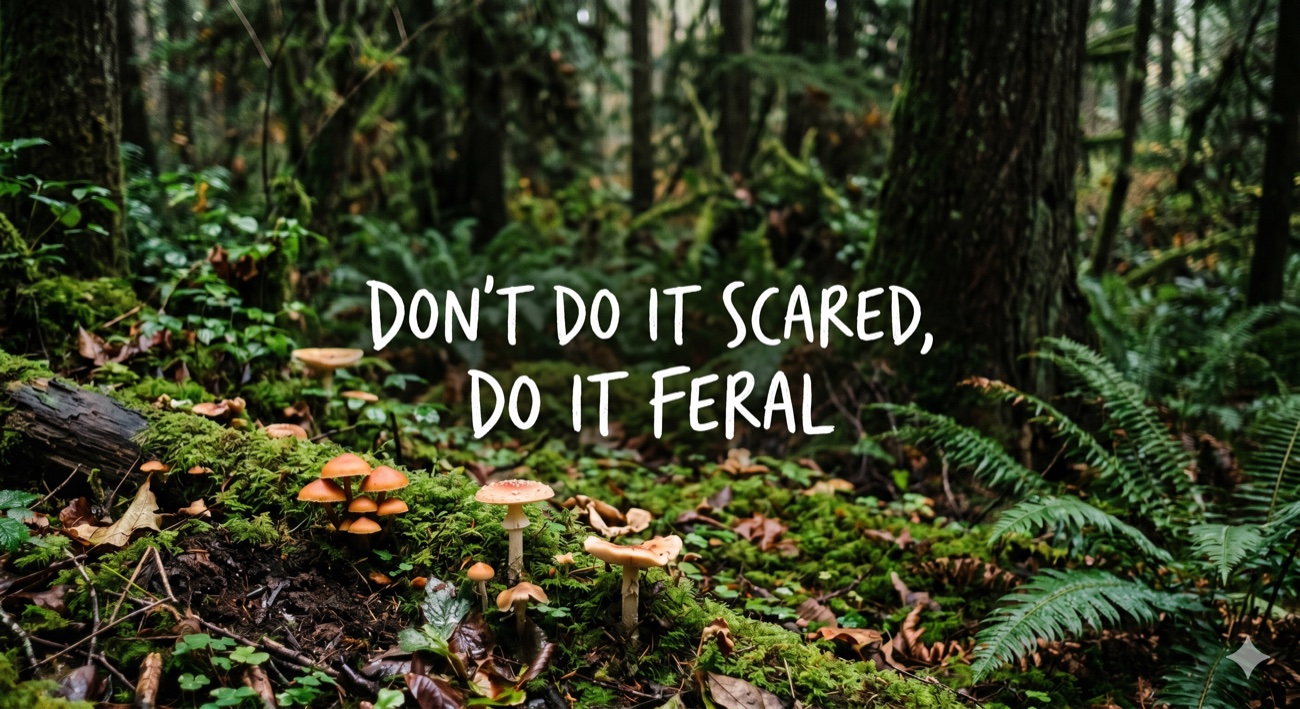
The next day, Linda Clark messaged me. She was letting me know about an upcoming webinar, and it felt like more than a coincidence.
I’d read her book Feral Guideship over the past year, and it had really stayed with me. Though the part about fear and feral, I hadn’t made the connection.
The premise of Feral Guideship is a neurodivergent, systems-thinking approach to being yourself in the world: you’re not too much. You don’t see things wrong. Your brain just needs the right tools. When you have them the way you move through the world is a feature, not a bug. It’s one of those books that doesn’t try to fix you. It guides you.
The word “feral” is clear to me here, but some have different reactions. Linda is careful about it: it’s not wild, not anarchy, not coming to work in your pajamas. It’s a reclamation. The idea being that you had self-trust once, probably when you were a kid jumping off something you shouldn’t have. Then a few decades of grades and approval-seeking and professional norms slowly trained it out of you. You’re not building something new. You’re getting something back.
In my mind, the opposite of feral is domestication, but it’s a spectrum. Some domestication is fine. It’s actually necessary. It’s what lets us live in society together, follow shared rules, function in organizations. A dog bred over thousands of years to need us is different from a cat, who was never fully domesticated in the first place.
Cats kept their instincts. Put one outside and it knows what to do. The feral version isn’t a different animal, it’s just one that never gave that up. What Linda is pointing at is similar: not losing the part of yourself that can still function on its own, that still trusts its own read on a situation, even inside a system.
So I attended the webinar today. And I was reminded, as I constantly need to be reminded because I fall out of practice, that uncertainty doesn’t have to be something you just push through.
One of the things Linda surfaced was a question that sounds almost too simple: What if I do nothing? Often a side note in decision making frameworks, it is so crucial.
Not what if I fail. Not what if I make the wrong move. What if I just… don’t? Or what if I wait?
She framed it as a discernment practice, a way to strip the emotion out and see a situation clearly. Come at the problem as if you’re encountering it for the first time. Then ask: if I did nothing, what would actually happen?
Some things will immediately reveal themselves as urgent. Others will quietly reveal themselves as noise. She mentioned that after she started doing this with her own inbox, she realized she’d been answering emails that never needed a reply. They were just telling her something, not asking her for anything.
It’s easy to forget that “nothing” is a real option. Especially for people who move fast and think in systems and want to solve the thing right now.
Feral isn’t reckless. It’s trusting your intuition enough to hear it. Not instincts. Linda draws that line carefully. Instincts are reflexes, things you’re born with. Intuition is the sum of everything you’ve learned. Every job, every failure, every thing you’ve read and tried and gotten wrong. Trusting your intuition isn’t soft. It’s trusting your own accumulated data.
So here’s what I’m sitting with this week, and I’ll leave it with you too: what’s the thing where you’re pushing yourself to act, to decide, to figure it out right now? What if you did nothing?
-Kate