Trudge Through the Desert Together
Shared ownership of hard work builds trust. Hero mode, hidden context, and emotional load concentration quietly teach teams to let one person carry too much.
I was listening to Handsome recently, and Mae Martin’s dad, James Chatto, asked whether anyone had ever had “a meaningful conversation with something that is not actually alive in its own right.”
Those who know me well know this is not exactly a stretch. I have a long history of naming things and assigning personalities, from keeping a marshmallow Peep as a pet until it was sticky and gross to naming my farm truck “Frank.” I think I did this the most when I was younger. Maybe adulthood suppressed the urge. Maybe I just have too many animate beings around now. Goats, dog, cats.
The first thing that came to mind with this question was Lambert.
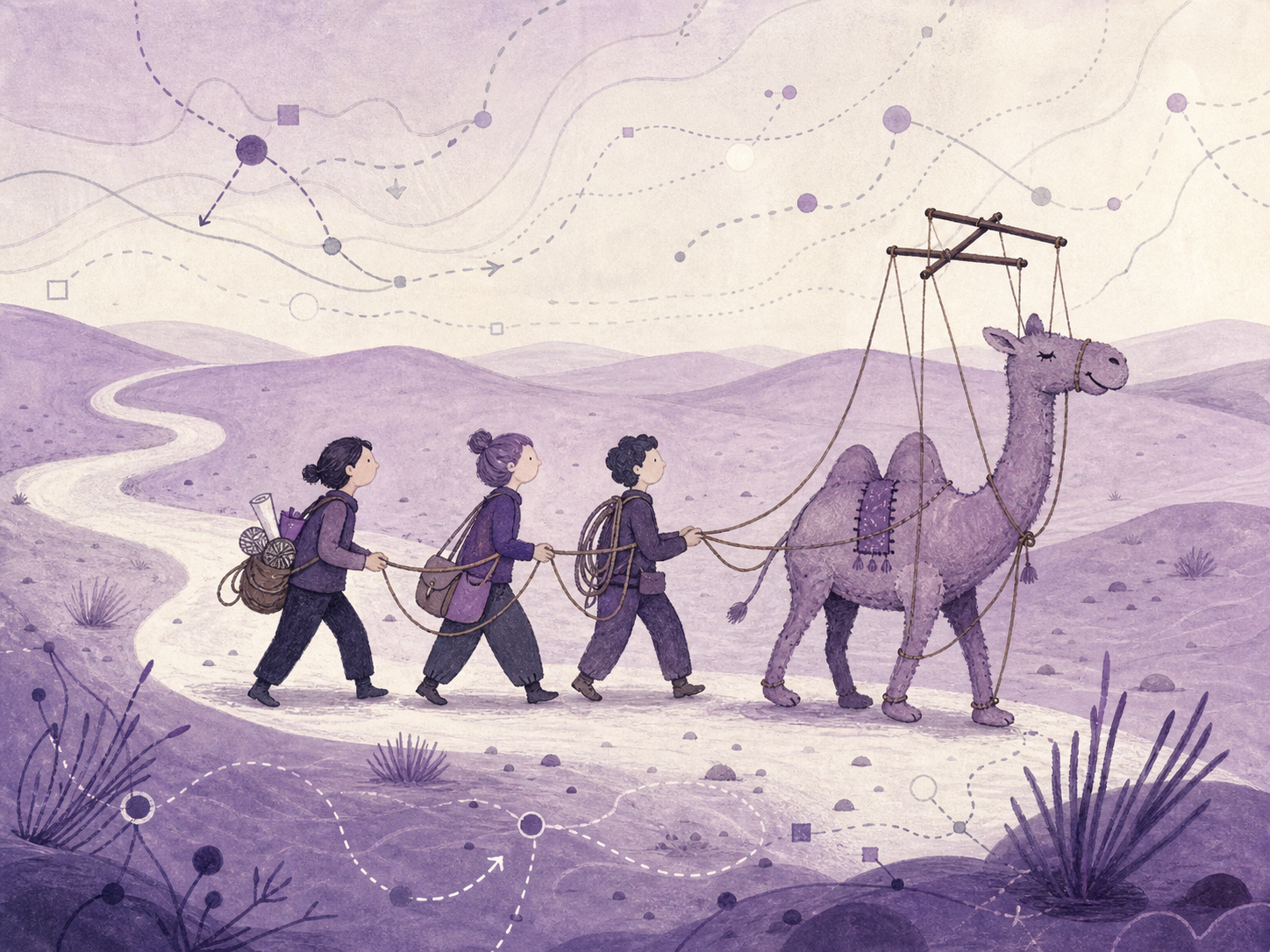
Lambert is a camel puppet. I still have him. When I was little, I hated going to school. My mom went to great lengths to try to get me to go to school. My parents even got a letter from the truancy officer when I was in high school.
My mom introduced Lambert into the situation during elementary school. Lambert would tell me about how he also had to go to school, and while at school he had to learn how to trudge through the desert.
This was apparently very important for all camels.
I do not remember whether this actually made me want to go to school. Probably not. School gave me great anxiety, and I much preferred to stay home and eat crackers behind the couch pretending I was a mouse. But I remember Lambert. I remember the idea that the work was not mine alone. Somewhere, somehow, a camel was also reporting for duty and learning the necessary skills of camel life.
He had to trudge through the desert too.
The Hard Part Should Not Belong To One Person
There is something useful in my mom’s creative parenting, beyond the excellent camel puppeteering.
The thing that helped was not that school became easy. It did not. The thing that changed was that the hard thing became relational. It was not just me against the day. It was me and Lambert, both with places to go and burdens to carry.
Teams need that more than we admit.
We talk about being “all in it together,” but many organizational patterns push people into trudging alone. One person stays up all night trying to save the day. One person becomes the only person who can fix the system. One person carries the emotional load of a project, a client, a launch, an incident, a board meeting, or a weird deadline that became weird three decisions ago.
Then the team tells itself it is resilient.
Sometimes what looks like resilience is just one person carrying a load everyone else has learned to ignore.
Hero Mode Has A Cost
I have a complicated relationship with hero mode because I understand why it happens. Sometimes something is genuinely on fire. Sometimes the deadline is real. Sometimes the customer is upset, the system is down, the grant report is due, or the thing that was supposed to be simple has revealed itself to be a many-headed operational creature.
And sometimes one person really does know the system better than everyone else. They can fix it faster. They know which config file matters, which hack shouldn’t work but does, and why something is the way it is. In the moment, letting that person handle it can look efficient.
The cost shows up later.
When one person is always the person who saves the day, the team stops building the muscle to save the day together. Everyone else may be grateful. They may admire the hero. They may even be relieved. But admiration is not participation, and relief is not shared ownership.
It can also be disempowering. If one person is the only one trusted to fix the hard thing, what does that tell everyone else? It tells them their judgment is optional. It tells them the work belongs to whoever is most willing to suffer. It tells them to wait, because eventually the usual person will pick it up.
That is how hero mode turns into learned helplessness.
The team may not mean to opt out. People are often responding to the system in front of them. If every crisis ends with the same person taking over, the team learns the pattern. The hero learns it too. Sometimes they become attached to being needed. Sometimes the organization rewards the drama. Sometimes leaders praise the rescue and skip the harder question: why did the rescue require the same person again?
Often the hero burns out and leaves.
Letting hero mode persist is a management choice.
The Lottery Factor
Technical teams often talk about the bus factor, or sometimes the lottery factor if you prefer a less graphic analogy. The question is basically: what would happen if this person left tomorrow?
It is a useful question, but I think teams often apply it too narrowly. They look for code ownership, passwords, deployment knowledge, or architecture decisions. That matters. If only one person knows how production works, you do not have a team.
But the same pattern exists outside the code.
Who knows the history of why the board cares about that metric in an oversized way? Who notices that two teams are using the same word to mean different things? Who remembers that the last launch failed because of a difference in config between production and dev? Who is quietly translating between engineering, product, leadership, and the humans who have to live with the decision?
That is also a lottery factor.
If one person holds all of that context, the team is fragile even if the documentation is beautiful. And that documentation is incomplete. The documentation can make the system look healthier than it is.
Emotional Load Counts
Some of the hardest work on teams does not look like work.
It looks like staying calm in the meeting. It looks like noticing that someone has gone quiet. It looks like explaining the same decision for the fourth time without making everyone feel foolish. It looks like absorbing ambiguity from leadership and translating it into something the team can actually do. It looks like keeping a client from panicking while also not throwing your team under the bus.
This is emotional load concentration. One person becomes the place where the discomfort goes.
Sometimes that person is a manager. Sometimes it is a senior engineer. Sometimes it is the person with the longest tenure, the best relationships, or the highest tolerance for mess. Often it is the person who is good at making the hard thing feel less hard for everyone else.
That can look like a gift. It can also become a trap.
If the same person always carries the discomfort, the rest of the team loses practice carrying it. They do not build the judgment, the relationships, or the scar tissue. They also may not realize what the work is costing. From the outside, the camel seems to be doing fine. Still walking. Still making it through the desert.
But carrying the load alone changes the relationship to the team. Shared hard work can build trust. Invisible hard work can drain it.
The difference is whether the burden is seen, shared, and designed around.
Shared Ownership Is A Culture Practice
The answer is not to make everyone suffer equally. Equal suffering is a strange goal and extremely hard to measure as not everyone considers the same things painful.
The answer is shared ownership of hard work.
That means bringing people closer to the uncomfortable parts before there is a crisis. Pair on the scary thing. Rotate who leads the incident review. Let someone newer sit in the difficult stakeholder conversation instead of only hearing the recap. Talk through the weird deadline before one person quietly turns it into a weekend problem. Make the implicit labor visible enough that the team can decide whether it is distributed in a way they are proud of.
It also means leaders have to notice what success is costing. “We got through it” is not enough information. Who got you through it? What did they absorb? What did the team learn? What did the team fail to learn because the usual person handled it again?
This is where trust gets built or eroded. People can handle hard work when they believe the team will move toward the hard thing together. They can handle discomfort when they believe it is not being quietly assigned to whoever has the weakest boundary or the strongest sense of responsibility.
But if people learn that the reward for competence is carrying more alone, they will eventually protect themselves. They may stop volunteering context. They may stop jumping in. They may leave. Or, sometimes worse for the system, they may stay and become the bottleneck everyone depends on and resents.
The desert is still the desert. Incidents happen. Weird deadlines happen. Systems fail in novel and personally inconvenient ways. No management framework makes the hard parts disappear.
But the hard part should not always belong to the same person.
Lambert had to go to camel school to learn how to trudge through the desert. I had to go to school too, though apparently with mixed results. The point was not that trudging was fun. The point was that I was not the only one doing it.
That matters on teams too.
Before the next weird deadline, incident, or organizational mess, ask yourself: who is actually carrying the load? Are you seeing these patterns on your team and aren’t sure where to start? Forward this essay to them and invite them to come trudge with you.
-Kate